
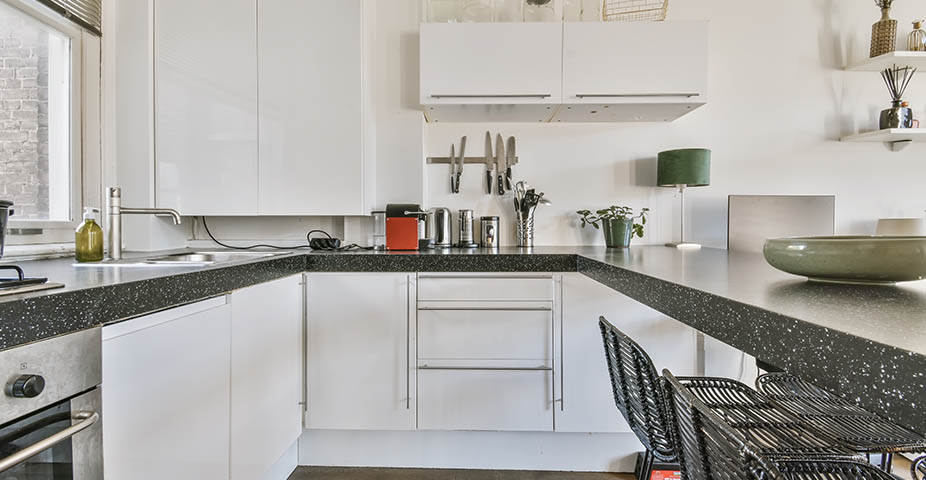
Gray granite countertops offer something that many stark white or deep black countertops can’t: a perfect balance of modern neutrality. They are versatile and also low maintenance because you won’t see noticeable finger smudges or scratches looking too visible on the surface. So, if you’re leaning towards a contemporary or transitional style that’s stylish but not too loud, gray can be the color to choose if you’re considering granite countertops. Here’s how to choose one.
Tips For Choosing Gray Granite Kitchen Countertops
Know Your Gray Shades
Gray granite comes in a surprisingly wide range of tones, from light silver and pearl to deep charcoal and almost black. Some slabs have cool undertones with blue or green hints, while others lean warm with beige or brown flecks. Before you shop, decide whether your kitchen feels warmer or cooler overall, since that will help you narrow things down fast.
Take photos of your cabinets, flooring, and walls before you visit the store. Seeing everything together prevents you from falling in love with a slab that clashes at home.
View Full Slabs, Not Just Samples
Small samples only tell part of the story with granite. Patterns, veining, and colors can vary dramatically across a single slab, and samples often come from a totally different section. Always ask to see the actual full slabs your fabricator would cut from, and view them standing up rather than flat when possible.
Walk around the slab, look at it from a few steps back, and check both ends. Two slabs from the same quarry can look noticeably different, so if you need more than one, make sure they’re from the same batch.
Identify Warm Vs. Cool Undertones
Not all grays are the same, and undertones make all the difference. Cool grays have blue, green, or purple tones, while warm grays carry beige, brown, or taupe flecks.
Look closely at your granite in natural daylight to spot these undertones, since indoor lighting can mask them. Then match accordingly: cool grays pair best with crisp whites, blues, and stainless steel, while warm grays complement cream, wood tones, and earthy colors.
Match With Your Cabinets
The best gray granite kitchens use contrast rather than matching the colors. If you have white, cream, or light wood cabinets, a medium or dark gray granite adds depth and makes the whole room pop. With dark navy cabinets, a pearl or a light silver granite keeps the space from feeling too cluttered.
If your cabinets are also gray, pick a granite that’s at least two or three shades lighter or darker, plus a different pattern, so the counters and cabinets don’t blend into one flat, lifeless block of color.
Simpler Backsplash and Flooring For Bold Countertops
If your gray granite has a lot of movement, speckle, or veining, keep the backsplash and floor simple and quiet. Solid subway tile, smooth neutral tile, or a barely-there texture lets the granite be the star. If your granite has subtle speckles, you’ve got room to play with a dramatic backsplash or patterned floor or a bolder wall paint. The key rule is one star per room.
Lay all three samples side by side before committing, and step back several feet to see how they read together from a normal viewing distance.
Consider Your Kitchen’s Size And Light
The shade of gray you pick should work with the room you have. Dark charcoal granite looks stunning in a large, sun-filled kitchen but can make a small or windowless kitchen feel cave-like and closed in. Light and medium grays reflect available light and keep compact spaces feeling open and bright.
If your kitchen gets strong afternoon sun, be aware that darker grays will show dust, fingerprints, and water spots more visibly. North-facing kitchens with cooler light flatter warmer grays, while sunny southern exposures can handle cooler, bluer gray tones beautifully. So, work with a granite contractor Rockville to choose something that works well in your kitchen’s lighting.
Choose Your Accent Colors And Fixtures
Gray granite is a neutral, which gives you tons of freedom, but a little planning keeps things cohesive. Gray pairs naturally with white, black, wood tones, and stainless, so those are safe bets for sinks, faucets, and hardware.
For pops of color, yellow, navy, sage green, and blush all play nicely with gray stone. Warm-toned granite with brown flecks looks great with oil-rubbed bronze or brass fixtures, while cool grays shine with chrome or matte black. Choose two or three accent colors max so the space feels intentional instead of scattered.
Choose The Right Finish
Granite finishes affect both looks and upkeep. Polished finishes are the most common because they bring out the stone’s color and resist stains better, but they do show fingerprints, water spots, and smudges more, which matters on gray stone.
Honed finishes have a smooth, matte appearance that hides marks well but can be slightly more porous. Leathered finishes add texture, mask crumbs and water rings nicely, and work great with darker grays.
Think about your cooking style too. If you wipe counters constantly, a polished or leathered surface will likely make daily life easier.
Think About Patterns And Movement
Gray granite ranges from speckled, uniform styles to bold slabs with dramatic veining and movement. Busier patterns hide crumbs, dust, and fingerprints far better, making them a smart pick for busy family kitchens. Subtle, consistent patterns create a calm, clean look but show every crumb and water spot.
Also consider the size of your kitchen. Bold veins can overwhelm a small space, while heavy speckle might feel busy in a big open kitchen. Bring your cabinet door sample along and hold it next to each option to see how the patterns interact.
Consider Sealing And Maintenance
Granite is naturally porous to some degree, and lighter grays often show it more. Ask about the stone’s absorption rate and plan to seal your counters after installation, then reapply sealer every year or two depending on use.
The water test tells you a lot: drip a little water on an unsealed spot and see how fast it darkens. Fast absorption means you need a good sealer and regular reapplication. The good news is that sealing takes minutes, and most gray granite slabs resist everyday spills like coffee and oil well once properly sealed.
Check Hardness And Durability Ratings
Granite is one of the hardest countertop materials available, but not all slabs are created equal. Some gray granite slabs are extremely dense and resist scratching and chipping with ease, while softer varieties with more veining can be a bit more vulnerable.
Ask your fabricator about the specific stone’s durability and how it handles heat, since most granite tolerates hot pans without a problem.
Inspect Slabs for Flaws Before You Buy
Natural stone can have fissures, pits, and mineral deposits, and not all of them are deal breakers. Small pits and speckles are normal parts of granite, but cracks that catch your fingernail could grow over time. Run your hands over the entire slab and look closely at the surface under good lighting.
Ask whether any visible lines are natural fissures, which are stable, or actual cracks that could worsen during cutting or daily use. Also confirm the slab is large enough for your longest run of counters so you can avoid visible seams.
Budget For The Whole Project, Not Just The Slab
Granite pricing goes way beyond the stone itself. Fabrication, cutouts for sinks and cooktops, edge detailing, backsplash pieces, delivery, and installation all add up quickly, so ask for a detailed, itemized quote. Thicker slabs usually cost more, as do intricate edges like ogee or waterfall styles. Prices also vary a lot between common, widely available grays and rare imports.
Conclusion
Gray granite can be the perfect addition to your kitchen if you choose it smartly by following the above-mentioned tips and by getting help from granite countertop installers Potomac.
